Master Independent Patent Valuation: A Step-by-Step Guide for CEOs
- ANTHONY VAGO
- 17 hours ago
- 9 min read

Introduction
For CEOs, the ability to accurately value patents is crucial for transforming intellectual property into a competitive advantage. This guide delves into the multifaceted benefits of accurate patent assessments, from enhancing company value to facilitating investment decisions and guiding licensing agreements.
Many CEOs struggle to identify the most effective valuation method for their patents, risking misalignment with their strategic goals. Failure to choose an appropriate methodology can lead to undervaluation of assets, ultimately hindering growth opportunities.
Selecting the right valuation methodology is not just a technical decision; it is a strategic imperative that can define a company's future success.
Understand the Importance of Patent Valuation
Patent appraisal plays a crucial role in strategic business management, particularly for CEOs aiming to enhance their company's competitive edge. Recognizing the importance of patent valuation yields several critical advantages:
Enhance Company Value: A well-assessed patent portfolio can substantially boost a company's market capitalization. For example, companies that efficiently manage their intellectual property (IP) have been shown to enhance their overall business worth, with over 50% of enterprises crediting IP ownership for an increase in their market value.
Facilitate Investment Decisions: Investors typically seek clarity regarding a company's intellectual property assets before committing capital. Precise intellectual property assessments offer crucial transparency, allowing companies to showcase their innovations as valuable business assets. This was evident when a fintech startup effectively integrated IP assessments into its investor presentations, securing funding more quickly and at a superior valuation than anticipated.
Guide Licensing Agreements: Comprehending the significance of intellectual property is essential for negotiating advantageous licensing conditions. Companies that can articulate the worth of their innovations are better positioned to monetize them effectively. For instance, a digital health startup utilized its intellectual property portfolio's worth to negotiate a territory-exclusive license, enhancing its market reach without diluting equity.
Support Mergers and Acquisitions: In M&A transactions, intellectual property assessments are instrumental in determining a company's overall worth, influencing negotiations and deal structures. A strong assessment can lead to more favorable terms, as observed in instances where companies successfully justified their worth during negotiations, resulting in agreements that exceeded initial expectations.
By leveraging intellectual property assessments, CEOs can strategically position their companies for sustained growth in a competitive landscape.

Prepare for the Valuation Process
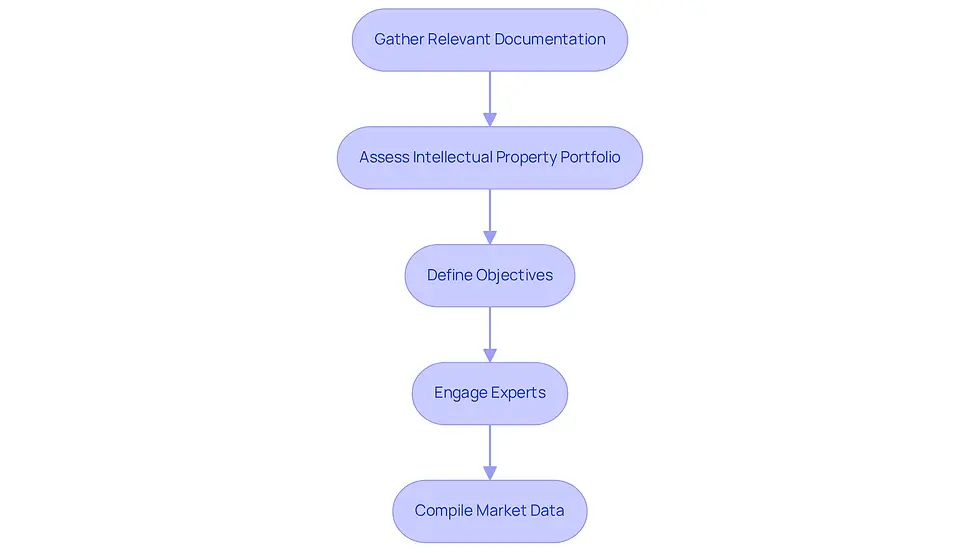
A thorough preparation process is vital for conducting an effective assessment of intellectual property. Here are the steps CEOs should take:
Gather Relevant Documentation: Comprehensive documentation is critical, as it facilitates the assessment process and mitigates risks associated with weak enforceability. Collect all necessary documents related to the inventions, including registration certificates, maintenance fees, and existing licensing agreements.
Assess Intellectual Property Portfolio: Review the entire intellectual property portfolio to identify which inventions are most relevant for valuation. Consider factors such as market relevance, technological significance, and potential revenue generation. A robust patent, defined by broad claims and an extended lifespan, holds significantly greater value than weaker patents.
Define Objectives: Clearly outline the purpose of the assessment. Whether for investment, sale, or internal assessment, having a defined objective will guide the appraisal process and influence the choice of methodologies.
Engage Experts: Engage appraisal specialists or consultants with expertise in intellectual property to ensure adherence to best practices and industry standards. Their expertise can enhance the credibility of the assessment and provide insights into complex transactions.
Compile Market Data: Investigate market trends and similar intellectual property assessments to provide context for your own inventions. This data is essential for choosing suitable appraisal methodologies, such as the relief-from-royalty method, which is commonly utilized in licensing negotiations.
Implementing these preparatory steps positions CEOs to conduct a thorough assessment of intellectual property, thereby maximizing shareholder value and bolstering investor trust.
Select Appropriate Valuation Methodologies
Selecting the right assessment method is essential for accurately determining the value of intellectual property, but many CEOs encounter significant challenges in performing an independent patent valuation. Sherwood Australia employs a comprehensive approach that distinguishes intellectual property valuation from traditional business valuation methodologies. The primary methodologies to consider include:
Cost Approach: This method assesses worth based on the expenses involved in creating the invention. It is especially beneficial for early-stage inventions that have yet to generate revenue. For instance, a health tech startup effectively employed this method to assess its intellectual property applications, estimating a current IP worth of approximately US$9.5 million, which greatly increased its attractiveness to investors.
Market Approach: This method contrasts the intellectual property in question with analogous rights that have been sold or licensed, offering a market-driven viewpoint on worth. It is most suitable for established inventions with available sales data, allowing for a clearer understanding of market positioning.
Income Approach: This method estimates the present value of future cash flows generated by the patent, making it ideal for patents expected to yield substantial revenue through licensing or product sales. Precise forecasting of revenue and costs is essential here, as income-based assessments rely significantly on these assumptions.
Hybrid Approach: By combining elements from the aforementioned methods, this approach provides a more comprehensive assessment. It is especially advantageous for intricate intellectual property portfolios that display varied traits, enabling a detailed evaluation of worth.
To make informed decisions, CEOs must evaluate the context of their patents and the specific goals of the independent patent valuation. Interacting with appraisal specialists, like those at Sherwood Australia, is also suggested, as their insights can greatly improve the precision and trustworthiness of the assessment process. Moreover, it is crucial to take into account possible legal ambiguities concerning IP rights, as these can greatly influence assessment results. With over 250 assessments delivered and AFSL licensing (No. 563351), Sherwood Australia guarantees legally compliant and defensible assessments. Ultimately, the choice of valuation methodology can significantly influence a company's strategic direction and investment potential, making informed decisions paramount.

Execute the Valuation and Analyze Results
Executing an independent patent valuation necessitates meticulous attention to detail and a structured approach to ensure accuracy and reliability. Once the methodology has been selected, executing the valuation involves several critical steps:
Input Data: Enter all relevant data into the selected assessment model. Small inaccuracies in data entry can lead to significant miscalculations in independent patent valuation outcomes, making precision and thoroughness crucial to prevent distorted results.
Run Assessment Models: Utilize assessment software or tools to implement the selected methodologies. This process involves independent patent valuation, which includes precise calculations of cash flows, thorough comparisons of market data, and detailed assessments of development costs. For example, a SaaS company recently employed a layered IP assessment model to justify its pricing strategy, connecting user behavior to protected technology.
Analyze Results: Review the output from the assessment models carefully. Look for trends, anomalies, and insights that can inform business decisions. For instance, a fintech firm effectively incorporated its intellectual property assessment in investor documents, which facilitated quicker fundraising and improved pricing, strengthening the brand's worth as a revenue-generating asset.
Validate Findings: Cross-check the results with industry benchmarks and expert opinions. This validation step is essential for ensuring that the assessment is credible and defensible. Organizations such as GHB Intellect highlight the significance of a multi-disciplined team to deliver impartial assessment reports that can endure examination in negotiations and disputes.
Prepare for Presentation: Organize the findings in a clear and concise manner, ready for presentation to stakeholders. This may involve creating visual aids or summary reports that highlight key insights and recommendations. Presenting these findings with clear data and insights can enhance stakeholder confidence and facilitate informed decision-making.
When CEOs follow these steps carefully, they can trust that their patent assessments will be accurate and play a crucial role in their strategic decisions. If the methodology and findings lack rigor and clarity, the credibility of independent patent valuation is at stake.

Document Findings and Present to Stakeholders
Effectively documenting and presenting assessment findings is essential for strategic decision-making in corporate finance. Here’s how to do it:
Create a Comprehensive Report: Document all aspects of the assessment process, including methodologies, data sources, assumptions, and final results. The report must be thorough to withstand scrutiny, as accurate independent patent valuation is vital for informed decisions in mergers, acquisitions, and licensing agreements. Sherwood Australia provides professionally prepared reports suitable for investor presentations and board use, ensuring that all critical elements are covered.
Highlight Key Insights: Summarize the most important findings clearly and concisely. Concentrate on how the assessment influences business strategy, investment opportunities, and potential risks. Revealing the values of intangible assets enhances transparency and supports better decision-making for investors. Significantly, the NPE acquisition share rose from 30% in Q4 2024 to 48% in Q1 2025, highlighting the increasing significance of independent patent valuation in the current market environment.
Prepare Visual Aids: Use charts, graphs, and tables to illustrate key points. Visual aids can assist stakeholders in rapidly comprehending intricate information and recognizing the implications of the assessment, particularly in a context where intangible assets greatly influence a company's overall value. The $2 billion in damages granted in the first half of 2025 further highlights the financial consequences of effective strategies for independent patent valuation.
Schedule Presentations: Arrange meetings with key stakeholders, including investors, board members, and management teams, to present the findings. Tailor the presentation to the audience, emphasizing aspects most relevant to them. Involving stakeholders in conversation can offer further insights and promote a collaborative method to utilizing the assessment results. Notably, Louis Carbonneau's upcoming address at the World IP Forum in Bangkok on November 19-20, 2026, underscores Sherwood Australia's pivotal role in industry discussions.
Encourage Feedback: After presenting the findings, invite questions and discussions. This engagement can yield essential information for the C-suite, enhancing quality and portfolio strategy, ultimately leading to a stronger market position. The recent $739 million Xoma Royalty acquisition serves as an important case study demonstrating the effect of effective independent patent valuation strategies.
By following these steps, CEOs can ensure that their patent valuation findings are well-documented, clearly communicated, and effectively utilized in strategic decision-making. Ultimately, the quality of independent patent valuation findings can significantly influence a company's competitive position in the market.

Conclusion
In an era where intellectual property is a key driver of business success, mastering independent patent valuation is not just beneficial but essential for CEOs. Understanding patent appraisal allows leaders to attract investment, negotiate better licensing agreements, and enhance their mergers and acquisitions strategy.
This article has highlighted the numerous benefits of patent valuation for companies. From increasing overall company value and facilitating investment decisions to guiding licensing negotiations and supporting M&A activities, each aspect underscores the critical role that a well-conducted patent assessment plays in driving business success. The detailed steps for preparing for the valuation process, selecting appropriate methodologies, executing the valuation, and effectively documenting and presenting findings provide a comprehensive roadmap for CEOs to follow.
In today's competitive market, CEOs must prioritize independent patent valuation to stay ahead. By embracing this approach, companies not only position themselves for growth but also foster transparency and trust with stakeholders. Ultimately, neglecting patent valuation could hinder a company's growth potential and diminish its competitive edge in the market.
Frequently Asked Questions
Why is patent valuation important for businesses?
Patent valuation is crucial for enhancing a company's competitive edge, boosting market capitalization, facilitating investment decisions, guiding licensing agreements, and supporting mergers and acquisitions.
How can a well-assessed patent portfolio affect a company's value?
A well-assessed patent portfolio can significantly increase a company's market capitalization, with over 50% of enterprises attributing their market value increase to effective management of intellectual property.
What role does patent valuation play in attracting investors?
Investors seek clarity about a company's intellectual property assets before investing. Accurate assessments provide transparency, allowing companies to present their innovations as valuable assets, which can lead to quicker and more favorable funding.
How does patent valuation assist in negotiating licensing agreements?
Understanding the value of intellectual property enables companies to negotiate better licensing terms. For example, a digital health startup used its IP portfolio's worth to secure an exclusive license, expanding its market reach without sacrificing equity.
In what way does patent valuation support mergers and acquisitions?
Intellectual property assessments are vital in M&A transactions as they help determine a company's overall worth, influencing negotiations and deal structures. Strong assessments can lead to more favorable terms during negotiations.
What are the key steps in preparing for the patent valuation process?
Key steps include gathering relevant documentation, assessing the intellectual property portfolio, defining objectives for the assessment, engaging experts, and compiling market data.
What types of documentation should be collected for patent valuation?
Necessary documentation includes registration certificates, maintenance fees, and existing licensing agreements related to the inventions.
How should a company assess its intellectual property portfolio?
Companies should review their entire portfolio to identify relevant inventions, considering factors like market relevance, technological significance, and potential revenue generation.
Why is it important to define objectives for the patent assessment?
Clearly defining the purpose of the assessment-whether for investment, sale, or internal evaluation-guides the appraisal process and influences the choice of methodologies.
Why should companies engage experts during the patent valuation process?
Engaging appraisal specialists or consultants ensures adherence to best practices and enhances the credibility of the assessment, providing valuable insights for complex transactions.
What is the significance of compiling market data for patent valuation?
Investigating market trends and similar assessments provides context for a company's inventions, which is essential for selecting appropriate appraisal methodologies, such as the relief-from-royalty method.