

Master IP Valuation for Legal Teams: A Step-by-Step Approach
- ANTHONY VAGO
- May 14
- 7 min read

Updated: 2 days ago
Introduction
Navigating the complexities of intellectual property (IP) valuation is essential for strategic business management, yet it remains a frequently underestimated factor in decision-making processes.
Legal teams equipped with a robust understanding of IP valuation can safeguard their clients' interests while enhancing negotiation power and financial reporting accuracy.
Legal professionals often struggle to navigate the complexities of various IP valuation methods, risking misvaluation of intangible assets.
This guide will provide actionable insights to help them select the right approach.
Understanding the nuances of IP valuation is not just beneficial; it is imperative for legal professionals aiming to enhance their clients' strategic positioning in the marketplace.
Understand the Importance of IP Valuation
Intellectual property (IP) valuation is not just a financial exercise; it is a strategic imperative for businesses today.
Strategic Decision-Making: Accurate IP valuation is crucial for informed business decisions, particularly in mergers and acquisitions, licensing agreements, and litigation strategies. Understanding the monetary worth of IP is crucial for legal teams, as effective IP valuation for legal teams enables them to negotiate better terms and protect their clients' interests. For instance, a health tech startup recently assessed its patent applications at around US$9.5 million using the income-based method, showing the impact of precise valuation on strategic decision-making.
Financial Reporting: The assessment of intellectual property holdings plays a significant role in financial statements, affecting a company's balance sheet and overall worth. Clarity concerning non-physical resources is becoming more significant to investors and stakeholders, particularly as non-material worth frequently surpasses physical worth in technology industries. This trend highlights the need for strong IP valuation for legal teams to accurately represent true worth, a service that Sherwood Australia is well-prepared to deliver, supported by their AFSL licensing for legally compliant evaluations.
Risk Management: Navigating the complexities of IP risks can be daunting without a clear understanding of its value. Understanding the value of IP is essential for assessing risks related to infringement, litigation, and competitive market dynamics. This understanding empowers businesses to proactively protect their assets and mitigate potential threats. Sherwood Australia's expertise in intellectual property assessment ensures that clients can navigate these challenges effectively.
Positioning in the Industry: A well-valued IP portfolio can significantly enhance a company's standing, making it more attractive to investors and partners. It offers an advantage in negotiations and can result in improved funding opportunities, as demonstrated by the increasing dependence on intellectual property assessment by startups in India to justify fair market worth during fundraising rounds. By leveraging Sherwood Australia's valuation services, companies can maximize the benefit derived from their intellectual property ownership.
Ultimately, a robust understanding of IP valuation can transform how businesses leverage their intangible assets in a competitive landscape.

Explore Valuation Methods for IP
Valuing intellectual property (IP) requires a nuanced understanding of various methodologies, each suited to specific contexts and asset types:
Cost Approach: This method estimates the value of IP based on the total costs incurred during its development, including research, prototyping, and other related expenses. It is particularly useful for early-stage technologies where market data may be scarce. For instance, development costs can reach up to $300,000 for an idea, setting a minimum valuation, particularly in software development, where recreating the work incurs significant costs.
Market Approach: This approach evaluates the worth of IP by comparing it to similar assets that have been sold or licensed recently. It is effective when adequate data is available to establish benchmarks. For instance, comparable sales of intellectual property can attain amounts of $500,000, making this method especially pertinent for established technologies. The market approach also considers the utility of the IP in the marketplace, as its worth is contingent on how well it integrates into commercially viable products or services.
Income Approach: This widely-used method assesses IP based on the present worth of anticipated future cash flows produced by the asset. It is especially beneficial for income-producing IP, such as patents and trademarks. The income approach estimates revenue over the remaining term of a patent, discounted to present value, and is crucial for understanding the long-term economic benefits of IP.
Each approach has its unique strengths and weaknesses, and the selection of method should correspond with the specific context of the assessment, including the type of IP, the purpose of the assessment, and the availability of data. At Sherwood Australia, we adopt a multi-methodology strategy, utilizing market, income, cost, and relief-from-royalty methods to ensure precise and justifiable assessments. By leveraging these methodologies, businesses can strategically position their IP assets to maximize their potential in the market.

Implement a Step-by-Step IP Valuation Process
Without a structured approach, IP valuations can easily become inaccurate and unreliable. To conduct an effective IP valuation, follow these steps:
Gather Relevant Data: Collect all necessary information about the IP, including industry trends, financial performance, and comparable transactions. This data will form the foundation of your assessment.
Choose the Appropriate Assessment Method: Based on the type of IP and the purpose of the assessment, select the most suitable method from the cost, market, or income approaches.
Conduct the Valuation: Apply the chosen method to calculate the value of the IP. Ensure that all assumptions and calculations are documented for transparency.
Review and Validate Results: Cross-check the assessment outcomes with industry benchmarks and seek feedback from stakeholders to ensure accuracy and credibility.
Prepare an Appraisal Report: Compile the findings into a comprehensive report that outlines the methodology, data used, and final assessment. This report should be clear and accessible to non-experts.
Implementing this structured approach enables legal teams to conduct IP valuation for legal teams that are not only thorough but also robust and defensible. A well-structured IP valuation can safeguard against potential disputes and enhance strategic decision-making.

Utilize Tools and Resources for Effective Valuation
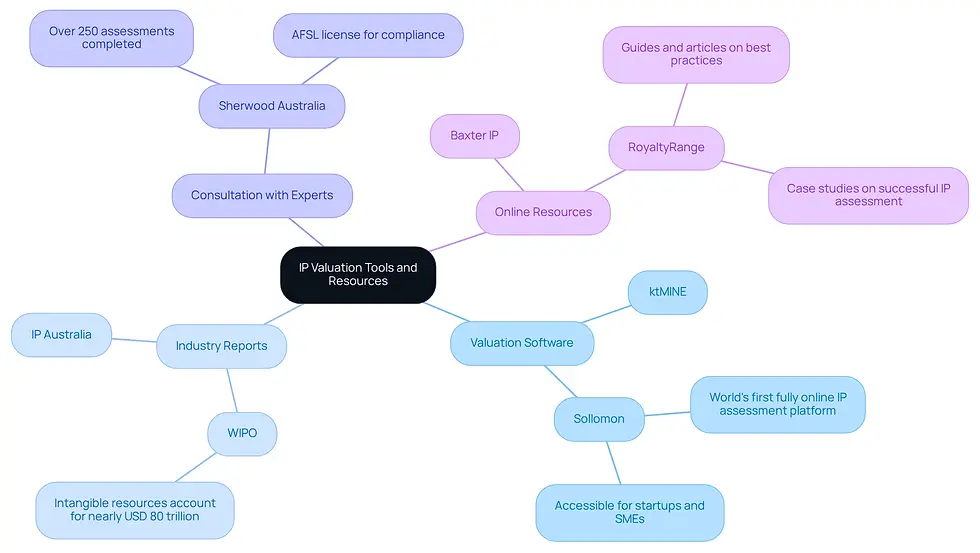
Many organizations find it challenging to accurately assess the economic value of their intellectual property, leading to potential financial losses. To enhance the IP valuation process, consider utilizing the following tools and resources:
Valuation Software: Platforms like ktMINE and Sollomon offer comprehensive databases and analytics for IP valuation, providing access to real-time data and benchmarks crucial for informed decision-making. Sollomon, for example, is recognized as the world’s first fully online IP assessment platform, making it accessible for startups and SMEs to comprehend their IP’s economic worth.
Industry Reports: Reports from organizations such as WIPO and IP Australia provide valuable insights into market trends and assessment standards. For instance, WIPO's recent discoveries show that intangible resources now account for nearly USD 80 trillion worldwide, highlighting the significance of precise IP assessment in the current economy.
Consultation with Experts: Engaging with experienced appraisal professionals, such as those at Sherwood Australia, can yield tailored insights and methodologies specific to your IP assets. With more than 250 assessments completed and an AFSL license guaranteeing compliance, Sherwood Australia stresses that 'Assessment is not a checklist.' It is the application of sound professional judgment, emphasizing the need for expert involvement in the assessment process.
Online Resources: Websites such as Baxter IP and RoyaltyRange offer guides and articles on best practices in intellectual property assessment, which serve as invaluable tools for legal teams focused on IP valuation to enhance their appraisal strategies. These platforms frequently showcase case studies that demonstrate successful IP assessment practices, further enhancing their utility.
Ultimately, leveraging these resources can transform how organizations approach IP valuation, ensuring they make informed strategic decisions that enhance their competitive edge.
Conclusion
In today's competitive business environment, the value of intellectual property (IP) is often underestimated, yet it is crucial for legal teams. Accurate IP valuation not only informs strategic decisions but also enhances financial reporting, risk management, and competitive positioning. Without accurate IP valuation, legal teams may struggle to make informed strategic decisions, risking financial misreporting and weakened competitive positioning. By mastering the intricacies of IP valuation, legal professionals can effectively advocate for their clients and ensure that intangible assets are leveraged to their fullest potential.
Throughout the article, key arguments highlighted the various methodologies for IP valuation, including the cost, market, and income approaches. Each method serves a unique purpose and is best suited to different contexts, emphasizing the need for a tailored approach based on the specific assets in question. Additionally, the structured step-by-step process outlined ensures that legal teams can conduct thorough and defensible valuations, ultimately safeguarding against disputes and enhancing decision-making capabilities.
As businesses begin to understand the true value of their intangible assets, they face new challenges and opportunities. It is imperative that legal teams prioritize IP valuation as a strategic imperative. By utilizing the right tools, resources, and expert insights, organizations can transform their approach to IP, ensuring they remain competitive and well-positioned in their respective markets. Neglecting IP valuation can result in organizations falling behind their competitors, unable to leverage their intangible assets effectively. Embracing robust IP valuation practices not only protects assets but also drives innovation and growth in an ever-evolving economic landscape.
Frequently Asked Questions
What is the importance of intellectual property (IP) valuation for businesses?
IP valuation is crucial for strategic decision-making, financial reporting, risk management, and positioning in the industry, helping businesses make informed decisions and protect their assets.
How does accurate IP valuation impact strategic decision-making?
Accurate IP valuation is essential for informed business decisions, especially in mergers and acquisitions, licensing agreements, and litigation strategies, allowing legal teams to negotiate better terms and protect clients' interests.
What role does IP valuation play in financial reporting?
IP valuation affects financial statements, influencing a company's balance sheet and overall worth, and is increasingly important to investors as non-material assets often exceed physical assets in technology sectors.
How does understanding IP value contribute to risk management?
Knowing the value of IP helps businesses assess risks related to infringement, litigation, and market dynamics, enabling them to proactively protect their assets and mitigate potential threats.
How can a well-valued IP portfolio affect a company's standing in the industry?
A well-valued IP portfolio enhances a company's attractiveness to investors and partners, improves negotiation leverage, and can lead to better funding opportunities, particularly for startups.
What services does Sherwood Australia provide in relation to IP valuation?
Sherwood Australia offers expertise in intellectual property assessment, ensuring legally compliant evaluations that help clients navigate IP valuation challenges effectively.


