

Master Patent Valuation for Acquisition Due Diligence: Best Practices
- ANTHONY VAGO
- 12 hours ago
- 8 min read

Introduction
In the competitive landscape of mergers and acquisitions, accurately valuing patents is crucial for maximizing company valuations. As companies increasingly recognize that intangible assets represent a staggering 90% of the worth of S&P 500 firms, the intricacies of patent valuation during acquisition due diligence become paramount. Stakeholders often struggle with the complexities of patent valuation, which can lead to significant financial repercussions.
This article will explore best practices for patent valuation, including:
Methodologies
Key influencing factors
Actionable strategies to avoid costly missteps in the acquisition process
Failure to accurately value patents can jeopardize the success of mergers and acquisitions, leading to diminished returns on investment.
Define Patent Valuation and Its Importance in Acquisition Due Diligence
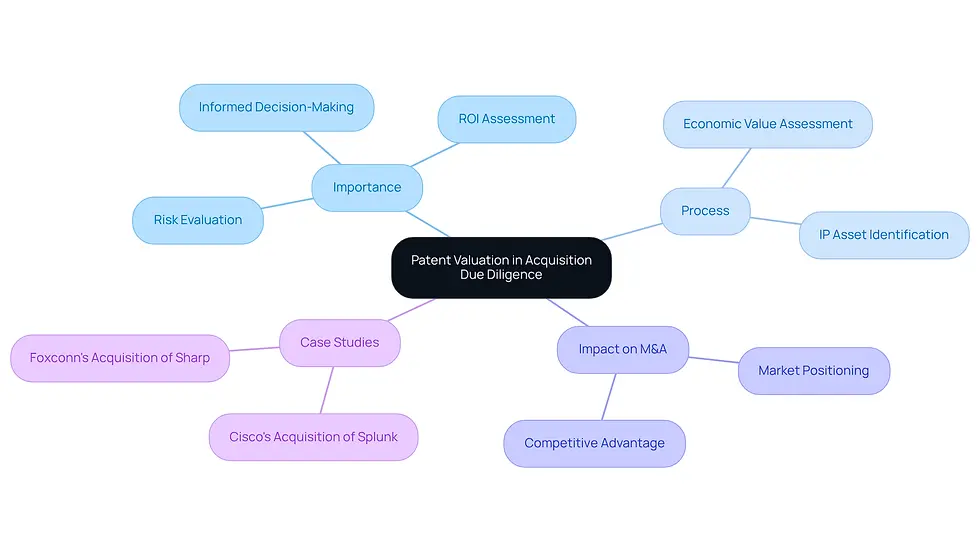
Patent valuation for acquisition due diligence is critical for informed decision-making regarding inventions. The process of assessing the economic value of an invention or a collection of inventions is critical in the context of patent valuation for acquisition due diligence, as it informs potential buyers about the worth of the intellectual property (IP) assets under consideration. This enables them to identify potential return on investment (ROI) and assess associated risks. In the realm of mergers and acquisitions (M&A), patent valuation for acquisition due diligence is crucial as intellectual property often represents significant assets that enhance a company's competitive advantage and market positioning. For instance, Cisco's purchase of Splunk for $28 billion was primarily supported by the sophisticated data analytics technology integrated into Splunk's innovations, which aligned strategically with Cisco's current security framework. This shows that a thorough assessment of intellectual property can significantly impact how purchase prices are justified and how integration strategies are developed.
Data reveals that a growing number of companies are prioritizing systematic IP due diligence in their acquisition strategies, with 60% of CEOs planning at least one acquisition in the next three years. As intangible assets now represent 90% of the worth of companies in the S&P 500, understanding patent valuation for acquisition due diligence is not merely an academic exercise; it is essential for informed strategic decision-making in M&A transactions. Efficient intellectual property assessment procedures, like those offered by Sherwood Australia, which usually produce reports within 14 days, can greatly influence deal evaluations. This is evident in Foxconn's acquisition of Sharp, where undisclosed liabilities led to a $900 million reduction in the offer due to inadequate IP due diligence. Moreover, using the incorrect assessment methodology can leave resources untapped, making patent valuation for acquisition due diligence essential for navigating the complexities of M&A transactions. A robust intellectual property assessment can be the difference between a successful acquisition and a costly oversight.
Explore Key Methodologies for Patent Valuation
Understanding the methodologies for patent valuation for acquisition due diligence is essential for making informed decisions in intellectual property management. Patent valuation employs several key methodologies, each tailored to specific contexts and objectives. The three primary approaches are:
Cost Approach: This method establishes a patent's worth based on the costs incurred during its development, including research and development expenses. It is especially advantageous for recently created innovations where commercial information may be restricted. Yet, this approach may undervalue the invention's true economic potential; for example, a creation costing £50,000 could generate £10 million annually.
Market Method: This method evaluates a patent's worth by examining similar transactions in the industry. By analyzing sales of comparable inventions, stakeholders can assess a reasonable market worth. This approach is particularly effective in sectors with active intellectual property trading, where the economic environment is shaped by standards-essential inventions (SEIs) that have grown more valuable because of their role in technical standards.
Income Approach: This method determines the present value of anticipated future cash flows produced by the intellectual property. It is especially pertinent for intellectual property expected to generate substantial income through licensing or product sales. This approach necessitates detailed financial projections and a thorough understanding of market dynamics, making it particularly appealing for startups aiming to demonstrate revenue potential to investors.
Relief-from-Royalty Method: This method calculates the worth of an invention based on the royalties that would be conserved if the invention were owned instead of licensed. This method is particularly useful for assessing the value of patents in negotiations where licensing agreements are a consideration.
Each methodology has unique strengths and weaknesses, and the choice of the suitable method should correspond with the specific objectives of the patent valuation for acquisition due diligence process. For instance, a startup may favor the income approach to highlight revenue potential, while a company preparing for divestiture might choose the market approach to establish a competitive sale price. Understanding these methodologies is crucial for effective negotiation and acquisition strategies, especially when considering patent valuation for acquisition due diligence. We prioritize defensible assessments by providing comprehensive reports that outline our methodologies, assumptions, and conclusions, specifically tailored for patent valuation for acquisition due diligence and investor presentations. Ultimately, selecting the appropriate valuation method can significantly influence negotiation outcomes and investment strategies.

Identify Factors Influencing Patent Valuation Outcomes
It is essential for stakeholders aiming to maximize their intellectual property investments to understand the factors influencing patent valuation for acquisition due diligence. Several factors can significantly influence the outcomes of patent valuations, including:
Legal Strength: The enforceability of a legal right, including its claims and the absence of prior art, plays a crucial role in its significance. Stronger patents with fewer legal challenges are generally valued higher. Sherwood Australia emphasizes that the strength of legal protection is essential for accurately evaluating the worth of IP-rich assets.
Market Demand: The commercial viability of patented technology significantly influences its valuation. Patents in high-demand sectors, such as artificial intelligence or biotechnology, tend to command higher worth due to their potential for revenue generation.
Technological Significance: The significance of the technology to current industry trends and consumer needs can influence valuation. Patents that address emerging technologies or solve pressing problems are often valued more highly, aligning with Sherwood Australia's approach to evaluating IP based on its commercial optionality.
Competitive Landscape: The number of rivals and the degree of innovation in the area can influence a patent's worth. Using the incorrect assessment method can lead to undervaluation, resulting in lost opportunities during negotiations. A trademark that offers a considerable competitive edge in a saturated field may be appraised more highly than one in a less competitive area.
Economic Conditions: Broader economic factors, such as market stability and investment trends, can impact intellectual property worth. During economic downturns, companies often become more risk-averse, leading to a decline in the perceived value of intellectual property.
Comprehending these elements enables stakeholders to more effectively evaluate the possible worth of intellectual property and perform patent valuation for acquisition due diligence. By recognizing these factors, stakeholders can enhance their strategic decision-making in intellectual property acquisitions, utilizing the expert appraisal services provided by Sherwood Australia, which has completed over 250 assessments and operates under AFSL Licence No. 563351.

Implement Best Practices for Effective Patent Valuation in Due Diligence
Effective patent valuation for acquisition due diligence is critical for informed decision-making. To ensure effective patent valuation, consider the following best practices:
Conduct Thorough Research: This involves reviewing patent applications, legal histories, and market evaluations to identify potential risks or opportunities, including inventorship conflicts and interferences that may affect the assessment.
Engage Experts: Collaborating with Sherwood Australia's IP assessment specialists can provide tailored methodologies and insights that enhance the assessment process. John M. Covert, Director at Sterne Kessler, emphasizes that their team’s extensive experience in patent and trademark law is crucial for managing due diligence in complex transactions.
Utilize Multiple Assessment Methods: Employ a combination of assessment methodologies, such as the Market Approach and Cost Approach, to cross-verify results. This multi-faceted approach helps mitigate biases and offers a more robust assessment framework, leading to more reliable outcomes. For instance, the brewing company's patent assessment utilized both approaches to evaluate its utility and design patents effectively.
Document Assumptions and Rationale: Clearly record all assumptions made during the assessment process, including the reasoning for choosing particular methodologies. This transparency is essential for justifying the worth to stakeholders and during negotiations, fostering trust and credibility.
Stay Informed on Industry Trends: Regularly review industry trends and technological advancements that may affect patent value. Neglecting red flags, like ongoing lawsuits or poorly drafted agreements, can turn a seemingly advantageous deal into a significant financial setback.
Prepare for Due Diligence Reviews: Anticipate inquiries and issues from prospective purchasers by preparing comprehensive reports that detail the assessment process, methodologies employed, and key findings. Sherwood Australia's comprehensive, professionally prepared reports are suitable for investor presentations and can facilitate smoother negotiations, ultimately leading to more favorable acquisition outcomes.
Implementing these best practices enhances patent valuation for acquisition due diligence, which leads to more informed decision-making and successful acquisition outcomes. Ultimately, a meticulous approach to patent valuation can safeguard against costly oversights and enhance negotiation outcomes.

Conclusion
Mastering patent valuation is essential for effective acquisition due diligence, as it enables stakeholders to make informed decisions about intellectual property assets. The economic assessment of patents not only helps in determining their worth but also plays a crucial role in shaping negotiation strategies and integration plans during mergers and acquisitions. Without a clear understanding of patent value, negotiations can falter, leading to missed opportunities. Recognizing the value of these intangible assets is essential for navigating the complexities of today’s business landscape.
The article highlights several key methodologies employed in patent valuation, such as:
Cost approach
Market approach
Income approach
Relief-from-royalty approach
Each method presents unique advantages and limitations, emphasizing the importance of selecting the right approach based on specific acquisition goals. Additionally, the factors influencing patent valuation outcomes, including:
Legal strength
Market demand
Technological significance
Competitive landscape
Economic conditions
are critical for stakeholders aiming to maximize their investments in intellectual property. Best practices like thorough research, engaging experts, and using various assessment methods can significantly improve the valuation process.
In the end, grasping patent valuation is crucial for any organization engaged in mergers and acquisitions. By prioritizing thorough assessments and staying attuned to industry developments, organizations can avoid costly missteps and achieve successful acquisition results. Embracing these best practices not only strengthens negotiation positions but also fosters long-term value creation in the ever-evolving market.
Frequently Asked Questions
What is patent valuation in the context of acquisition due diligence?
Patent valuation in acquisition due diligence is the process of assessing the economic value of an invention or a collection of inventions, which informs potential buyers about the worth of intellectual property (IP) assets under consideration.
Why is patent valuation important in mergers and acquisitions (M&A)?
Patent valuation is crucial in M&A as intellectual property often represents significant assets that enhance a company's competitive advantage and market positioning, impacting purchase price justification and integration strategies.
Can you provide an example of how patent valuation influenced a major acquisition?
An example is Cisco's purchase of Splunk for $28 billion, where the assessment of Splunk's sophisticated data analytics technology significantly influenced the acquisition due to its strategic alignment with Cisco's security framework.
What percentage of CEOs are planning acquisitions in the next three years?
Data indicates that 60% of CEOs are planning at least one acquisition in the next three years.
What is the significance of intangible assets in companies today?
Intangible assets now represent 90% of the worth of companies in the S&P 500, making understanding patent valuation essential for informed strategic decision-making in M&A transactions.
How quickly can efficient intellectual property assessment procedures produce reports?
Efficient intellectual property assessment procedures, such as those offered by Sherwood Australia, can typically produce reports within 14 days.
What impact can inadequate IP due diligence have on an acquisition?
Inadequate IP due diligence can lead to significant financial consequences, as seen in Foxconn's acquisition of Sharp, where undisclosed liabilities resulted in a $900 million reduction in the offer.
What can happen if the incorrect assessment methodology is used in patent valuation?
Using the incorrect assessment methodology can leave resources untapped and hinder effective navigation of the complexities involved in M&A transactions, making proper patent valuation essential.


